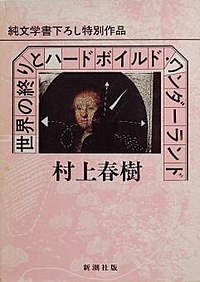
While the narrator from the hard-boiled wonderland is sarcastic, loud, and unwilling to get involved, the narrator at the end of the world is quiet and thoughtful. He's not complacent, but he's willing to let things progress on their own until he can get his answers. At the beginning of the book, he arrives at the end of the world: a small village enclosed within wall and surrounded by mysterious horned beasts. The man has no recollection of his previous life - he doesn't remember where he came from, or even what his name is. All he knows is his shadow, who seems to have more knowledge of the two of them (The shadow is very interesting in that he doesn't trust the town and seems eager to escape, but that is a matter for another time). However, upon entering the town, the shadow is taken from him, and the narrator is assigned the inexplicable task of dream reading.
Instead of answering questions, however, the narrator's job just creates more. And this is why I like the second narrator. He's just as confused as the first narrator, but unlike the first narrator he goes looking for answers. Where the first narrator avoids his problems and puts off dealing with them for as long as he can, the narrator from the end of the world looks (albeit hesitantly) for explanations. Even when he isn't entirely sure on something, his shadow can usually convince him to look closer. This is my other favorite kind of narrator: the one who is completely lost and looking for answers.
The narrator from the end of the world is, as I mentioned earlier, assigned the job of dream reading upon his entry to the town. This job introduces some parallels to the story that I thought were really interesting. The dream reader works in the library, where he reads old dreams from the skulls of the village's horned beasts (they're unicorns but horned beasts sounds way more interesting) for hours on end. Sound familiar? It does to the narrator. As he looks at the skull, he is "overcome by a strange sense of deja vu. [...] Is this a fragment of a real memory or has time folded back on itself? (60)" There are actually several parallels here. Both narrators are presented with mysterious unicorn skulls that they don't quite know what to do with. To find answers, they go to the library, where they meet the attractive young woman working there and (maybe) fall a little bit in love. That seems a bit too similar for it to be a coincidence.
It's clear that the narrators are related in some way, but I still don't know exactly how. I can't tell what is happening when. Are the two stories happening simultaneously, or is one before the other? Are the narrators the same person, or two different people leading strangely similar (and yet entirely different) lives? Right now, my hypothesis is that the events happening in the hard-boiled wonderland are leading up to the ones at the end of the world, but that raises a whole new set of questions. If that's the case, what happens to the first narrator to make him forget who he is? I can't even begin to guess. Thoughts?