How does one go about reflecting on an entire year of reading? I can barely remember what I was thinking about yesterday, let alone how I felt about a book that I read at the beginning of the school year. However, something about the books I read this year really stuck in my mind. All of them were interesting to me, and even my least favorites (like Independent People - sorry Dad!) had their moments. I think I can safely say that I took something from each of them, be it a valuable observation on how the simplest interlude can effect your perception of the overall story or a silly one on how boring it is to read about a guy who lives in the mountains with some sheep.
Going off of that, I think that I learned something about myself with each new book. From Independent People, I learned that I'm not necessarily a mature enough reader to be interested in such a contemplative book. Actually, I found that with many of the books I wasn't always mature enough to grasp the concepts entirely. While I could read them and enjoy them, it always felt like there was something that I wasn't quite getting. Maybe I don't have all the experiences necessary to understand the deeper meaning within the text. Take The Plague, for instance. It was an excellent book, probably my favorite all year, but for much of the time I felt like there was something missing - some key experience or knowledge that would help me unlock an entirely new level of understanding.
This is especially true with The Third Policeman, which I'm not quite done with yet. I've been told repeatedly that it's fantastic, and that if I don't understand it that's okay because it'll all make sense soon. But I can't help but wonder if there's something I've missed, some inside joke that would make the book a million times better if I could only understand it. As of right now, it's an interesting book to read but I don't get it at all. Each new section of reading only makes me more confused, and I don't think that's what should be happening. Isn't the story supposed to make more sense as you read further? This is not the case with The Third Policeman, and I'm not sure if that's by design or not.
One book that I did think I understood was Les Miserables, but I'm pretty sure something was up with that one too. Everyone I've talked to about it has complained about reading "the brick" at some point, but when I was reading it didn't seem like a brick at all. That's not a comment on my reading abilities - my copy (which I've now lost, so I can't check for sure) claimed to be the complete and unabridged version, but I think it was lying. Either that or it was a terrible translation; I'm not sure which. Regardless, I felt like I understood the characters and was able to read deeper into the text, something that I tend to struggle with. Reading a book that I understood after so many that I struggled with was reassuring.
Another thing I struggled with this year, aside from the books themselves, was time management (something that is true in nearly all aspects of my life, not just my reading). I found that when I got busy, which I so often was, reading was no longer a priority. Despite the fact that it is something I enjoy and something that I should have been doing for a grade, I went for days at a time without picking up a book, only to race through one in a weekend. Even after reading a book, I often neglected to write about it, which meant that my blog here just barely kept going, with huge gaps between posts and then several at once. Basically, because of my personal failures I didn't accomplish everything that I should have. My reading list remains unfinished, and there aren't nearly as many posts on this blog as I would have liked.
However, that doesn't mean that I've given up! I found that I really enjoyed blogging about what I was reading. The discussions it prompted were often ones that helped me look at the books in a different way, and I think that's very valuable. I really enjoyed having the input from my friends and family, and I think that helped me a lot. As a result, I've decided that I'm going to keep this blog going! As I mentioned earlier, I didn't finish my reading list, so there's plenty to talk about. The posts probably will be even less frequent, but I think that's okay. I really enjoyed running this show this semester, so it makes sense to continue.
So here's basically what happened this year: I read some books. Some I loved, some I wasn't sure about, and some I thought were an absolute bore, but I learned something from each of them. I learned that I'm not as mature of a reader as I thought I was, which is (in my opinion) a pretty valuable lesson. I also learned that I don't necessarily understand everything I read, but that's okay. You can still enjoy a book even if you don't pick up on all of the subtleties in it. I really struggled with managing my time this year, and in the end I couldn't quite beat it, which meant I didn't do everything I should have. Despite these struggles, though, I enjoyed the time I spent blogging, so I'm going to continue doing so over the summer! I learned a lot this year, and all of that learning was valuable. Thanks for joining me for the ride! I'll see you cool cats later.
Wednesday, June 5, 2013

The Third Policeman (well, 2 out of 3 isn't bad)
I am over halfway done with Flann O'Brien's The Third Policeman and I'm still not entirely sure that I know what's going on. So far, the narrator's dad has died, he's gone away to school, he's come back from school to work on the family farm, he's killed a guy (one of these things is not like the other), and he's had a conversation with the man he supposedly murdered. No, it doesn't make sense to me either. This book is very, very odd.
Anyways, I am not really going into depth on any of these strange events because there are even stranger events to follow. After his conversation with Mathers (the man he thought he had killed), the narrator embarks on a journey to the police barracks, where he is to meet two of the three policemen who work there. And let me tell you, they are pretty much crazy. Like, honest-to-goodness losing it. Before I pass judgement on these two zany officers, though, let me explain.
The Sergeant is obsessed with bicycles. It sounds weird, but it's true. He seems under the impression that all crime, and all life in fact, revolves around bicycles. This leads to some pretty humorous exchanges. For example, upon the narrator's arrival at the police station he seems astonished that there was no bicycle involved in his travels. He goes through just about every type of wheeled transportation available trying to find the one on which the narrator arrived, going as far as a velocipede before giving up. Later, he explains his crazy theory on how, through the transfer of atoms, humans are turning into bicycles and vice versa (anyone who knows anything about science should know that this is absurd). It was at this point that I began questioning the sanity, and the effectiveness for that matter, of these two officers. And the Sergeant is the more normal of the two.
The other officer is called MacCruiskeen, and he is an odd one for sure. For many years, in addition to his police work, MacCruiskeen has been making boxes. Every box is exactly the same in all but size, because as the number of the box gets higher the box itself gets smaller.The highest numbers are so small that they are completely invisible, and millions of them would fit into the first box. It hurts my head to think about, and I'm pretty sure it almost drove the narrator insane. In a book filled with odd characters, I think MacCruiskeen is the strangest thus far.
Basically, I don't know what's going on in this book and I think all of the characters are nuts. For some strange reason, though, I like it! I hope that at eventually there will be an "aha" moment and I'll understand the point of this book, but even if I don't it's definitely an interesting read. Have any of you read this before? Do you remember having a moment of sudden understanding, or was it all just confusing?
Anyways, I am not really going into depth on any of these strange events because there are even stranger events to follow. After his conversation with Mathers (the man he thought he had killed), the narrator embarks on a journey to the police barracks, where he is to meet two of the three policemen who work there. And let me tell you, they are pretty much crazy. Like, honest-to-goodness losing it. Before I pass judgement on these two zany officers, though, let me explain.
The Sergeant is obsessed with bicycles. It sounds weird, but it's true. He seems under the impression that all crime, and all life in fact, revolves around bicycles. This leads to some pretty humorous exchanges. For example, upon the narrator's arrival at the police station he seems astonished that there was no bicycle involved in his travels. He goes through just about every type of wheeled transportation available trying to find the one on which the narrator arrived, going as far as a velocipede before giving up. Later, he explains his crazy theory on how, through the transfer of atoms, humans are turning into bicycles and vice versa (anyone who knows anything about science should know that this is absurd). It was at this point that I began questioning the sanity, and the effectiveness for that matter, of these two officers. And the Sergeant is the more normal of the two.
The other officer is called MacCruiskeen, and he is an odd one for sure. For many years, in addition to his police work, MacCruiskeen has been making boxes. Every box is exactly the same in all but size, because as the number of the box gets higher the box itself gets smaller.The highest numbers are so small that they are completely invisible, and millions of them would fit into the first box. It hurts my head to think about, and I'm pretty sure it almost drove the narrator insane. In a book filled with odd characters, I think MacCruiskeen is the strangest thus far.
Basically, I don't know what's going on in this book and I think all of the characters are nuts. For some strange reason, though, I like it! I hope that at eventually there will be an "aha" moment and I'll understand the point of this book, but even if I don't it's definitely an interesting read. Have any of you read this before? Do you remember having a moment of sudden understanding, or was it all just confusing?
Tuesday, June 4, 2013
Les Mis 3: Cosette & Marius
Anyone who has delved deeper into the realm of Les Miserables probably knows the popular opinion on Cosette. In a cast of well-loved characters, she is often seen as the least favorite. She was written, I think, as someone that should be liked by everyone, and instead she is liked by almost no one. I think the main reason people tend to dislike Cosette is her perfection. She is, for all intents and purposes, practically flawless. To a reader, that isn't likeable. It's annoying. I don't want to read another episode of "Cosette's Perfect Day" because that's boring. If the only thing a character does is have one fabulous day after another, it's frustrating. A person can't learn anything from days like that. Valjean, however, does his very best to make sure all of Cosette's days are perfect, especially after rescuing her from the Thenardiers. It's a nice idea, but it ends up creating a character who is naive and childish. Because of her privileged, sheltered lifestyle, Cosette remains a static character for most of the book. Her constant happiness ends up being vexing for the reader, and she isn't even kind of relatable.
Once Marius is introduced, she becomes slightly more human. Now, instead of being relentlessly happy all the time, Cosette has emotions. When Marius is gone she misses him. When she thinks he might be in danger, she's worried for him. When it seems they might be separated, she's distraught. Cosette is still puppy-dog happy most of the time (and when she isn't it usually has to do with Marius), but she's getting there. I wouldn't say that Marius causes her emotional growth, however. Instead he acts as more of a catalyst. In chemistry, the catalyst is added to a reaction in order to speed it up. The reaction will happen regardless, but it'll go a lot faster with the catalyst present. This is what Marius does for Cosette - he helps her grow up a little bit faster. Without Marius, Cosette surely would have come upon this emotional maturity at some point. However, his presence helps her reach this point faster.
Do you think that Marius causes Cosette's emotional growth, or is he more of a catalyst as I suggested?
Once Marius is introduced, she becomes slightly more human. Now, instead of being relentlessly happy all the time, Cosette has emotions. When Marius is gone she misses him. When she thinks he might be in danger, she's worried for him. When it seems they might be separated, she's distraught. Cosette is still puppy-dog happy most of the time (and when she isn't it usually has to do with Marius), but she's getting there. I wouldn't say that Marius causes her emotional growth, however. Instead he acts as more of a catalyst. In chemistry, the catalyst is added to a reaction in order to speed it up. The reaction will happen regardless, but it'll go a lot faster with the catalyst present. This is what Marius does for Cosette - he helps her grow up a little bit faster. Without Marius, Cosette surely would have come upon this emotional maturity at some point. However, his presence helps her reach this point faster.
Do you think that Marius causes Cosette's emotional growth, or is he more of a catalyst as I suggested?
Monday, May 20, 2013
...and the End of the World
While the narrator from the hard-boiled wonderland is sarcastic, loud, and unwilling to get involved, the narrator at the end of the world is quiet and thoughtful. He's not complacent, but he's willing to let things progress on their own until he can get his answers. At the beginning of the book, he arrives at the end of the world: a small village enclosed within wall and surrounded by mysterious horned beasts. The man has no recollection of his previous life - he doesn't remember where he came from, or even what his name is. All he knows is his shadow, who seems to have more knowledge of the two of them (The shadow is very interesting in that he doesn't trust the town and seems eager to escape, but that is a matter for another time). However, upon entering the town, the shadow is taken from him, and the narrator is assigned the inexplicable task of dream reading.
Instead of answering questions, however, the narrator's job just creates more. And this is why I like the second narrator. He's just as confused as the first narrator, but unlike the first narrator he goes looking for answers. Where the first narrator avoids his problems and puts off dealing with them for as long as he can, the narrator from the end of the world looks (albeit hesitantly) for explanations. Even when he isn't entirely sure on something, his shadow can usually convince him to look closer. This is my other favorite kind of narrator: the one who is completely lost and looking for answers.
The narrator from the end of the world is, as I mentioned earlier, assigned the job of dream reading upon his entry to the town. This job introduces some parallels to the story that I thought were really interesting. The dream reader works in the library, where he reads old dreams from the skulls of the village's horned beasts (they're unicorns but horned beasts sounds way more interesting) for hours on end. Sound familiar? It does to the narrator. As he looks at the skull, he is "overcome by a strange sense of deja vu. [...] Is this a fragment of a real memory or has time folded back on itself? (60)" There are actually several parallels here. Both narrators are presented with mysterious unicorn skulls that they don't quite know what to do with. To find answers, they go to the library, where they meet the attractive young woman working there and (maybe) fall a little bit in love. That seems a bit too similar for it to be a coincidence.
It's clear that the narrators are related in some way, but I still don't know exactly how. I can't tell what is happening when. Are the two stories happening simultaneously, or is one before the other? Are the narrators the same person, or two different people leading strangely similar (and yet entirely different) lives? Right now, my hypothesis is that the events happening in the hard-boiled wonderland are leading up to the ones at the end of the world, but that raises a whole new set of questions. If that's the case, what happens to the first narrator to make him forget who he is? I can't even begin to guess. Thoughts?
Tuesday, May 7, 2013
Hard-Boiled Wonderland...
Hey all! I know it's been a while (oops) but now that the musical is done with I hope to get back into the swing of things. I have misplaced the copy of Les Mis with all of my annotations, so I'm taking a break from that one until I find it again. For now, I've switched to Haruki Murakami's Hard-Boiled Wonderland and the End of the World. I know, it's a mouthful. Anyways, enjoy!
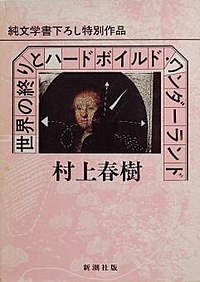 | |
| This book right here. Check it out. No, seriously, read this book. |
I am pretty quickly beginning to think that Hard-Boiled Wonderland and the End of the World is going to be my favorite book of the year. Already things are lining up in its favor: it has my two favorite types of narrators, an intriguing plot, and a really excellent cast of characters. Right now I'm going to be looking at one of the two narrators, this one from the hard-boiled wonderland that is the future (there's a second narrator at the end of the world, but that's an entirely different matter).
In a futuristic world where data is everything, the unnamed narrator is an unassuming Calcutec thrust into an adventure that he doesn't necessarily want. He is my first type of narrator - a quiet guy who lives his own life, has his own goals, and finds himself in the middle of everything even though all he wants to do is go home and sleep. He's quite the character. His disbelief and somewhat snarky tone endear him to me all the more. For example, he says things like "for convenience sake, I agreed to entertain to entertain the remote hypothesis that the owner of said skull might be, conceivably, a unicorn. [...] Great, I thought. Just great. Why were all these things happening to me? (Murakami 80)" This quote actually sums up his role in the story pretty well. He's willing to entertain the idea that all of these crazy things are actually happening, even though he has absolutely no desire to get involved. For some reason, that makes me like his character a lot.
I would say that the narrators defining characteristic is his reluctance. Because he doesn't want to be there, he's sassy and a little bit rude. He's pretty disgruntled for much of the story, and I think that's his way of disguising the fact that he's scared. And of course he is! This is a crazy adventure. He's risking his life for something he isn't sure he even believes in, and that's frightening. This makes him human, and relatable, and that's why I love the narrator living in the hard-boiled wonderland.
Friday, April 12, 2013
Les Mis 2: Javert
Another character who has always interested me is Javert. Upon meeting this determined officer of the law, we learn several things about him. Javert was born in a prison (his mother a fortuneteller and his father a criminal), and he felt that he was forever doomed to remain on the fringes of society. At the same time, Javert was making an observation: "society closes its doors, without pity, on two classes of men: those who attack it and those who guard it; he could choose between these two classes only" (Hugo 54). As anyone who has seen the musical or read the book knows, he very firmly places himself on the side of the law. He goes to great lengths to remain there, despite the de facto exile from society.
Javert's character is defined by his strongest views - he respects and admires authority, and hates rebellion. This love of authority is what leads to his determination to abide by and enforce the law, no matter what the situation may be. His hatred of rebellion is what leads to him becoming an officer in the first place. Javert considers "theft, murder, all crimes" (Hugo 55) to be forms of rebellion. His hatred of rebellion, then, is naturally a large part of why he is so determined to stop the revolution that the Friends of the ABC begin. If all crimes are forms of rebellion, then to Javert an actual rebellion must be the most criminal act of all.
In any other story, Javert likely would have been a character the reader can say is a "good guy," albeit an unlikeable one. His determination to do right by the law would be something to admire. However, most of the likeable characters in Les Miserables are not the good, law abiding citizens who would think of Javert as being on their side. Jean Valjean is an escaped convict. Fantine is forced to turn to prostitution to support her daughter. The Friends of the ABC are staging a rebellion. Since all of these sympathetic characters clash with Javert and his black and white view of the world, it is only natural that we as readers find him a bit distasteful. Do you think that Javert could have been a "good guy," or is he too strict for even a law abiding citizen?
Javert's character is defined by his strongest views - he respects and admires authority, and hates rebellion. This love of authority is what leads to his determination to abide by and enforce the law, no matter what the situation may be. His hatred of rebellion is what leads to him becoming an officer in the first place. Javert considers "theft, murder, all crimes" (Hugo 55) to be forms of rebellion. His hatred of rebellion, then, is naturally a large part of why he is so determined to stop the revolution that the Friends of the ABC begin. If all crimes are forms of rebellion, then to Javert an actual rebellion must be the most criminal act of all.
In any other story, Javert likely would have been a character the reader can say is a "good guy," albeit an unlikeable one. His determination to do right by the law would be something to admire. However, most of the likeable characters in Les Miserables are not the good, law abiding citizens who would think of Javert as being on their side. Jean Valjean is an escaped convict. Fantine is forced to turn to prostitution to support her daughter. The Friends of the ABC are staging a rebellion. Since all of these sympathetic characters clash with Javert and his black and white view of the world, it is only natural that we as readers find him a bit distasteful. Do you think that Javert could have been a "good guy," or is he too strict for even a law abiding citizen?
Monday, April 8, 2013
Les Mis 1: The Bishop
From the first time I saw Les Miserables (the musical, that is), the character of the bishop has been one of my favorites. His simple lifestyle and the enormous impact he has on the life of Jean Valjean both endeared him to me, and his characterization in the book did not disappoint. If anything, I love him even more. The simplicity with which he strives to live is something I admire, and his benevolence is inspiring. I absolutely adore the description of his loves - "At his feet something to cultivate and gather, above his head something to study and meditate upon; a few flowers on the earth, and all the stars in the sky." This gentle man spends his leisure time gardening and contemplating God's work.
The love of nature and his devotion to his religion certainly draw me to the bishop's character. While I am not much of a gardener, I love nature. The night sky in particular has always fascinated me. One of my favorite things to do during the summer is to lie down and look at the sky. The simple act of just watching is incredibly meditative to me. Whether I need time to think or just an opportunity to clear my mind, the night sky is always there. While I imagine that the bishop and I are contemplating slightly different things, the connection is still there.
In my opinion, the bishop is one of the story's most important characters. While he is not physically present for the majority of the story, he has an undeniable impact on Jean Valjean's life. Without the key moment in which the bishop saves Valjean from the police, there would be no story. Valjean would go back to prison and remain the hateful man that he was before the bishop bought his soul for God. While it was certainly up to Valjean to become an honest man after his encounter, who knows if he would have had the chance without the bishop?
The love of nature and his devotion to his religion certainly draw me to the bishop's character. While I am not much of a gardener, I love nature. The night sky in particular has always fascinated me. One of my favorite things to do during the summer is to lie down and look at the sky. The simple act of just watching is incredibly meditative to me. Whether I need time to think or just an opportunity to clear my mind, the night sky is always there. While I imagine that the bishop and I are contemplating slightly different things, the connection is still there.
In my opinion, the bishop is one of the story's most important characters. While he is not physically present for the majority of the story, he has an undeniable impact on Jean Valjean's life. Without the key moment in which the bishop saves Valjean from the police, there would be no story. Valjean would go back to prison and remain the hateful man that he was before the bishop bought his soul for God. While it was certainly up to Valjean to become an honest man after his encounter, who knows if he would have had the chance without the bishop?
Subscribe to:
Comments (Atom)